


Trees & plants
We fell in love with Naturaleza Y Gracia for its trees. From Costa Rica's national Guanacaste tree, to the matapalo or Strangler fig tree we have a plethora of giant beauties here on the property. Another cherished feature is the Orchard we have planted with the efforts of our amazing gardener, Victor. The orchard is home to over 10 different species of fruiting plants like papaya, banana, rambutan, avocado, and more. In collaboration with Osa Conservation we were able to plant many different endangered tree species as well here on the property in an effort to reforest the property.
Strangler Fig Tree
Ficus aurea

This magnificent tree species is what the Costa Ricans refer to as the matapalo or "stick killer". Hailing from a dense rainforest environment where competition for light is very strong, the tree adapted to have strangling capabilities in order to survive off of the nutrients of other nearby trees.
We have a couple Strangler Fig Trees here in Naturaleza y Gracia, one toward the entrance to the property just across from Casa Sol, and others out on the beach in front of Casa Mar.
Conservation status: Least concern
Guanacaste Tree
Enterolobium cyclocarpum

The towering Guanacaste Tree is a local favorite as well as a national symbol of Costa Rica. In some cases this tree can reach over 35m (115ft) tall and have a diameter of 3.5m (11ft). These magnificent trees are enjoyed by many of our favorite animals. such as the howler monkey, the three toed sloth, and the green iguanas. Here in Naturaleza y gracia, you can find 3 different Guanacaste trees right on our very own beach front.
Conservation status: Least concern
The Walking Palm
Socratea exorrhiza
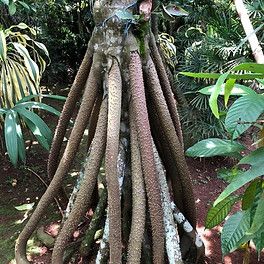
This tree gets its name from the special process for which its roots grow. The walking palm is characterized by it's "stilt" roots which lifts the trunk up and out of the ground so that it is sitting about a meter (3 ft) off the ground. It is such a treat to see the new roots for as they begin by extending out from the base of the palm until they find open soil out in front of them. Watching this process above-ground gives this tree the notion that it is "walking" or moving increasingly.
Conservation status: Least concern, but decreasing population due to loss of habitat
Papaya Tree
Carica papaya

The papaya is one of the most delicious tropical fruits native here to Costa Rica. The papaya tree must be female in order to bear fruit, and the fruit starts out growing in green pear shapes. When the papaya fruit has fully ripened it will have a yellow-orange color on the outside and a deep juicy orange color to the inside. The small black papaya seeds have shown to be an effective treatment to help detox the body of parasites.
Conservation status: N/A